FSB Warns Private Credit's Hidden Risks Could Threaten Financial Stability
What's New
The Financial Stability Board's Report on Vulnerabilities in Private Credit, delivers the most comprehensive global regulatory assessment of the $1.5 to $2 trillion private credit market to date, flagging rising defaults, opaque valuations, deepening bank interconnections, and growing retail investor exposure as potential systemic fault lines that remain untested by a prolonged downturn.
Why It Matters
Private credit has quietly become comparable in size to both the institutional leveraged loan market (~$1.5 to $1.7 trillion) and the high yield bond market (~$2 trillion), yet operates with far less transparency, fewer standardized metrics, and fragmented regulatory oversight across jurisdictions. The FSB's intervention signals that global regulators are moving from observation to action, with four formal workstreams now planned to address data gaps, cross-border supervision, and nonbank interconnectedness.
Big Picture Drivers
Regulatory arbitrage: Post-crisis bank capital rules pushed lending activity toward less regulated private credit channels, accelerating the asset class's growth at a 13 to 17% annual clip across major markets
Yield hunger: Institutional investors (insurers, pension funds, endowments) poured capital into private credit seeking illiquidity premia and diversification, with PE-linked insurers now controlling nearly $900 billion in insurance liabilities
Structural evolution: Semi-liquid fund structures (perpetual BDCs, evergreen funds with quarterly redemptions) are replacing traditional closed-end vehicles, introducing liquidity mismatch risks that surfaced in early 2026 redemption waves
AI infrastructure financing: Private credit's share of AI-related deals reached 34% in 2025 (up from a 17% five-year average), with an estimated $800 billion needed from private credit to fund projected $2.9 trillion in AI infrastructure capex through 2028
Consolidation: The top five asset managers in the UK now control over 50% of gross assets in UK-managed private credit funds, and globally, five large groups account for roughly one third of aggregate industry loan commitments
By The Numbers
$1.5 to $2 trillion: Estimated global private credit market size as of end-2024
5 to 6x: Typical debt-to-EBITDA leverage for private credit borrowers (potentially ~7x when EBITDA adjustments are stripped out)
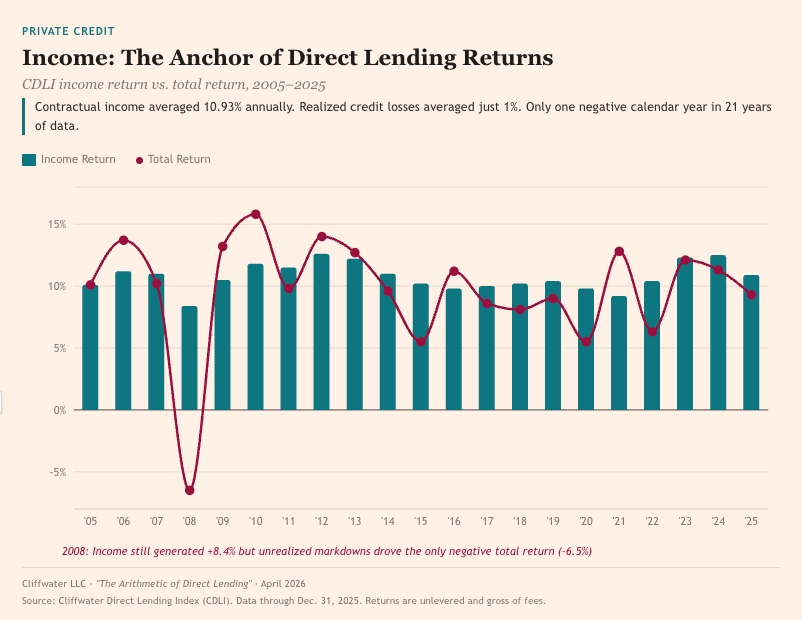
~5%: Default rate when selective defaults and distressed exchanges are included (vs. ~1% for outright defaults alone)
$220 billion+: Drawn and undrawn bank credit lines to private credit funds identified by FSB members, though commercial data suggests the true figure could exceed $500 billion
12%: Share of private credit loans utilizing PIK (payment-in-kind) arrangements, a signal of borrower stress
Key Trends to Watch
Redemption pressure is real: Several large semi-liquid private credit funds received redemption requests exceeding their 5% quarterly caps in early 2026, forcing managers to invoke structural limits and raising questions about whether retail investors fully understand illiquidity risk.
Private ratings are proliferating with limited oversight: Smaller, lesser-known credit rating agencies are increasingly providing private ratings used by insurers for regulatory capital purposes, accompanied by reports of ratings inflation that could obscure true credit quality.
Bank interconnections run deeper than headline numbers suggest: Beyond direct lending, banks provide revolving credit to companies simultaneously borrowing from private credit funds, invest in private credit CLO tranches, and engage in synthetic risk transfers. Roughly half of private credit borrowers also maintain financing relationships with banks.
Data gaps are a systemic blind spot: Most FSB member authorities cannot separately identify private credit funds in their regulatory reporting frameworks, lack granular loan-level data, and face legal impediments to sharing what limited information they do collect.
The Wrap
The FSB report is a clear signal that global regulators view private credit's rapid growth, deepening interconnections with banks and insurers, opaque valuations, and expanding retail access as a credible financial stability concern. The market's relatively benign loss experience to date reflects a period that has not included a prolonged economic downturn at current scale. For institutional participants, the practical takeaway is to expect tighter supervisory scrutiny, new data reporting requirements, and increased pressure on valuation governance and transparency in the near term.


Comments